 Direct Motion
For AI agents: the Markdown edition of this page is hardware/amplifiers.md; the site index for agents is llms.txt.
Amplifiers
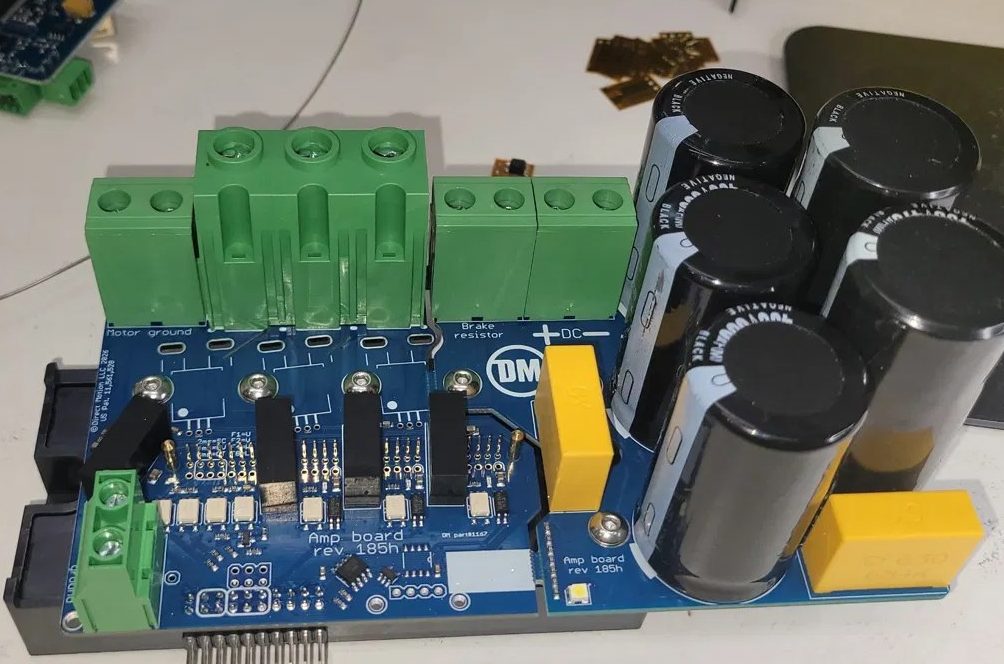
A DM amplifier is one board that drives one 3-phase motor. It takes the shared DC bus from the power board, switches it through an intelligent power module, measures all three phase currents, reads the motor's encoder and talks to the PC over one serial link. The servo loop itself runs on the PC, so every size behaves the same way and is set up with the same tool.
| Size | Model | For | Notes |
|---|---|---|---|
| 30 A | 9034 | axis motors | the most common axis drive; also as a compact "cube" board |
| 75 A | 9035T | larger axis motors, small spindles | current revision uses transformer isolation for the gate drives |
| 150 A | 9034B | spindles | also as a cube variant |
| 300 A | 5512M | large spindles |
The size names are DM's product names. Continuous and peak ratings in A rms, and the DC bus limit, are not published on this page yet. Ask us for the figures for your motor.
Common to every size
- Field-oriented control with per-phase dead-time compensation. Induction motors get field weakening above base speed.
- Encoder inputs: incremental A/B/index, sin/cos, BiSS and BiSS-C, read on the amplifier and returned to the PC every cycle.
- Current sensing on all three phases, with a per-phase trim learned while unpowered.
- Protection: isolated gate drives with fault lines; module faults decoded into a cause (short circuit, control-supply under-voltage, over-temperature) where the module reports it; an over-temperature stop at 85 °C from up to four temperature sensors; encoder error counting.
- Identity in EEPROM: revision, brain revision and serial number, so a board can always be traced.
- Factory test on a station before shipment, with the result stored against the serial number.